

TL;DR:
- Streetwear references embody cultural symbols rooted in specific communities, histories, and acts of resistance. Understanding these references requires decoding their origins, meanings, and ongoing narratives within local ecosystems and through ethical engagement. Genuine cultural weight in streetwear comes from authentic community involvement, layered storytelling, and respectful interpretation rather than surface aesthetics.
Streetwear cultural references are the symbolic meanings embedded in designs, graphics, and brand rituals rooted in specific communities, histories, and acts of resistance. To understand streetwear cultural references fully, you need to look past the hoodie and read the story underneath. The style traces its origins to skateboarding, hip-hop, and urban art scenes of the 1980s and 1990s, with figures like Nigo (founder of BAPE) and Edison Chen (co-founder of CLOT) building entire cultural languages through their brands. This guide covers the semiotic frameworks, ethical considerations, and regional examples that turn a casual observer into a genuinely informed reader of streetwear’s visual vocabulary.
How streetwear references express identity and culture
Streetwear began as a form of refusal. Marginalized communities in New York, Los Angeles, and Tokyo used clothing to signal belonging, reject mainstream fashion hierarchies, and assert identity on their own terms. That origin story is not just history. It is the reason every graphic, colorway, and limited drop carries weight beyond aesthetics.

Brands convert cultural value into commercial value through a model built on three pillars: symbol translation, aesthetic integration, and ritual reinforcement. The Chinese brand CLOT demonstrates this clearly. Its offline events and exhibitions create cultural identification among Gen Z consumers who participate in a shared loop of meaning-making. The brand does not just sell clothing. It stages cultural experiences that make the references legible to insiders.
Nigo’s approach with BAPE follows the same logic. His brand drew from Harajuku street culture, American Americana, and Japanese punk simultaneously, layering references that rewarded close reading. The cultural storytelling embedded in BAPE’s shark hoodies and camo patterns was never accidental. Each design element pointed back to a specific cultural moment or community.
Here is what distinguishes brands that carry genuine cultural weight from those that borrow surface aesthetics:
- Community origin: The reference comes from a community the brand is genuinely part of, not one it observed from outside.
- Ritual reinforcement: Pop-ups, limited drops, and concept stores create offline-online loops that deepen the meaning of each reference over time.
- Insider legibility: The symbols mean something specific to the people they represent, not just something visually striking to outsiders.
- Narrative continuity: References connect across collections and years, building a coherent cultural archive rather than isolated graphics.
Pro Tip: When you encounter a brand you do not recognize, look at its event history before its product catalog. A brand that runs community events, collaborations, and cultural spaces is building real references. One that only drops graphics is borrowing them.
How to decode streetwear’s cultural references
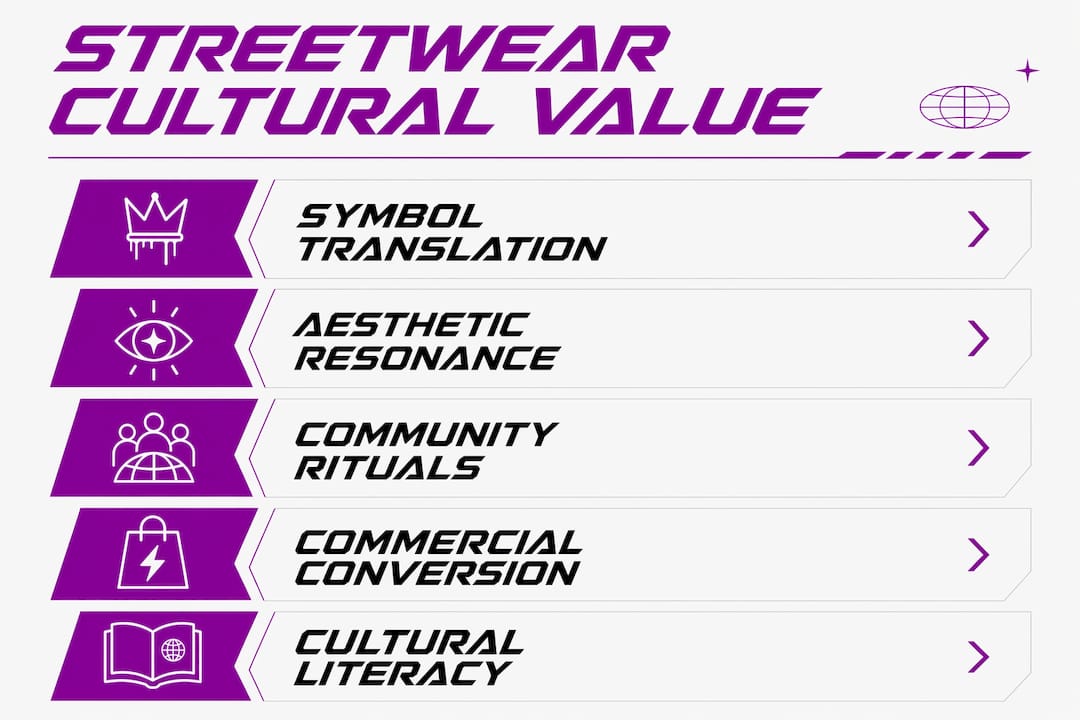
The most useful framework for reading streetwear symbols comes from the French theorist Roland Barthes. His mythmaking model describes how meaning cycles from a real garment to its image to a written or cultural narrative, forming myths that evolve over time. Research applying Barthes’s mythmaking process to fashion shows that streetwear references are continuously remythologized. Fans, media, and brands reinterpret the same garment across cycles, layering new meanings onto old ones. A Supreme box logo means something different in 2026 than it did in 1994, even though the graphic has barely changed.
Here is a practical four-step process for decoding any streetwear reference:
- Identify the source community. Ask where this symbol, pattern, or phrase originates. Is it from a specific city, subculture, or historical moment? Arabic typography on a Dubai streetwear piece points to a specific regional identity, not a generic “exotic” aesthetic.
- Trace the translation. How did the symbol move from its origin community into the brand’s design language? Was it adapted with care, or lifted without context? Symbol translation and integration determines whether a reference reads as authentic or appropriated.
- Check the ecosystem. Does the brand’s broader activity (collaborations, spaces, events) support the reference? Authentic references emerge from repeated cultural participation, not single-use graphics.
- Read the myth layer. What cultural narrative has built up around this piece over time? Museum curation helps here. The Nigo retrospective at London’s Design Museum uses over 700 objects to show how garments, packaging, and marketing form a single cultural narrative system. Seeing a piece in that context changes how you read it.
The table below maps common streetwear reference types to their decoding approach:
| Reference type | Origin signal | How to decode it |
|---|---|---|
| Graphic typography | Language, script style | Research the language community and its cultural context |
| Pattern or textile | Regional craft tradition | Trace the pattern to its geographic and historical source |
| Brand logo or mascot | Founder’s cultural world | Study the founder’s background and stated influences |
| Colorway | Subcultural coding | Look at how the color combination was used historically in the source scene |
| Collaboration | Shared cultural values | Read both brands’ histories to understand what the partnership signals |
Pro Tip: Museum exhibitions are one of the most underused tools for cultural literacy in streetwear. The Nigo retrospective frames garments as cultural history and self-portrait simultaneously. Attending or researching exhibitions like this gives you a semiotic education that no product page can replicate.
Ethical considerations when engaging with streetwear cultural references
Not every cultural visual in streetwear is respectful or meaningful. Ethical literacy in fashion requires understanding provenance and power relations, not just aesthetics. The difference between cultural appreciation and harmful appropriation comes down to credit, permission, and context.
Cultural appreciation means engaging with a tradition while acknowledging its source, supporting the community it comes from, and understanding its significance. Appropriation strips the symbol from its context, often profiting from a community that receives nothing in return. The Navajo Nation’s legal dispute with Urban Outfitters over trademarked tribal patterns is the most cited example in fashion law. The case revealed a core problem: IP laws inadequately protect communal indigenous knowledge because they are built around individual authorship and time-limited protection. A community’s cultural heritage does not fit neatly into either category.
The Australian Milpurrurru case recognized communal cultural harm in a copyright dispute, but it remains an isolated ruling without broad legal precedent. Trademark law can only partially address cultural misuse. The legal system is not a reliable guide to ethical behavior in this space. You need cultural literacy to fill the gap.
“The question is not whether a design looks good. The question is whether the people whose culture it draws from were consulted, credited, and compensated.” This standard applies whether you are a brand designer or a consumer choosing what to wear.
When you engage with streetwear that references specific cultural traditions, ask yourself:
- Does the brand credit the source community explicitly?
- Is there evidence of collaboration with or support for that community?
- Does the brand’s history show ongoing engagement, or is this a one-off visual?
- Would a member of the source community recognize this as respectful?
These questions do not require a law degree. They require the habit of asking before buying or wearing.
How regional streetwear scenes embed local culture and language
The most instructive examples of authentic cultural referencing come from regional scenes that build entire ecosystems around local identity. Dubai’s streetwear wave is one of the clearest current examples. Brands like Amongst Few and Love Closely integrate Arabic typography, ghitra-inspired patterns, and Urdu poetry directly into their designs, embedding local identity at the level of the garment itself.
What separates these brands from those that use regional aesthetics as decoration is ecosystem-building. Amongst Few operates concept stores that function as cultural spaces, not just retail environments. The store becomes a site of recurring cultural participation, which is exactly what authentic streetwear references require to carry weight. A graphic on a t-shirt means more when you bought it at a space where the culture it references is actively practiced and discussed.
The comparison below shows the difference between surface-level and ecosystem-level cultural referencing:
| Approach | What it looks like | What it signals |
|---|---|---|
| Surface referencing | Single graphic using a cultural symbol, no community ties | Trend-chasing, low cultural literacy |
| Ecosystem referencing | Symbol integrated across products, events, and physical spaces | Genuine cultural participation and long-term investment |
Understanding streetwear trends at a regional level means recognizing that the most credible references come from brands that live inside the culture they reference. You can spot this by looking at a brand’s streetwear collaborations and event history alongside its product catalog.
Pro Tip: Follow regional streetwear publications and social accounts from cities outside your own. Dubai, Lagos, Seoul, and São Paulo each have distinct streetwear ecosystems with their own reference systems. Exposure to multiple scenes sharpens your ability to distinguish authentic cultural embedding from borrowed aesthetics.
Common mistakes when trying to understand streetwear cultural references
The most common error is reading a graphic at face value without asking where it comes from. Surface reading treats streetwear as decoration. Cultural reading treats it as text. The difference matters because misreading a symbol can mean wearing something whose meaning you would reject if you understood it.
Here are the mistakes worth avoiding:
- Trend-chasing without context. Buying a piece because it is popular without understanding its reference system means you are wearing a story you have not read. That is fine for fast fashion. Streetwear operates differently.
- Mistaking commercialization for authenticity. When a reference goes mainstream, it often loses the specific meaning it carried in its origin community. A symbol that once signaled insider belonging can become empty branding within a single product cycle.
- Ignoring creator narratives. Brand founders and original designers usually explain their references directly in interviews, lookbooks, and brand histories. Reading these primary sources is the fastest way to understand what a piece actually means. The streetwear authenticity framework at Phazewrld covers this in detail.
- Skipping the community layer. References that come from specific communities (skate crews, hip-hop collectives, regional art scenes) carry meanings that only become clear when you engage with those communities directly, through events, publications, or conversations.
The fix for all of these mistakes is the same: slow down and research before you consume. Exhibitions, brand interviews, community forums, and cultural journalism all provide the context that turns surface reading into genuine understanding.
Key takeaways
Streetwear cultural references are readable only through cultural literacy, semiotic awareness, and ethical engagement with the communities that created them.
| Point | Details |
|---|---|
| Streetwear as cultural text | Every graphic and symbol carries a specific origin story that requires research to read accurately. |
| Semiotic decoding framework | Use Barthes’s mythmaking model to trace how meanings evolve from garment to cultural narrative over time. |
| Ethics before aesthetics | Ask whether source communities were credited and consulted before engaging with culturally specific references. |
| Regional ecosystems matter | Authentic references come from brands embedded in local culture through events, spaces, and ongoing participation. |
| Avoid surface reading | Research creator narratives, community voices, and brand histories to move past trend-level understanding. |
Streetwear literacy is a practice, not a destination
At Phazewrld, we have watched the conversation around streetwear’s cultural significance shift considerably over the past few years. What used to be a niche discussion among collectors and cultural journalists is now central to how young adults engage with the style. That shift is genuinely good. But it has also produced a new kind of superficiality: people who use the language of cultural literacy without doing the actual work.
The uncomfortable truth is that understanding streetwear’s references is not something you achieve once and carry forward. Meanings shift. Communities evolve. A symbol that carried one meaning in 2010 may carry a completely different one now, and the only way to stay current is to stay engaged. That means reading brand histories, attending events, following regional scenes, and being willing to be wrong about what something means.
What we find most rewarding about this space is that genuine engagement with streetwear culture almost always leads back to the people who created it. When you trace a reference to its source, you usually find a community with a rich story that the mainstream fashion world has only partially told. That is where the real value of streetwear’s cultural significance lives. Not in the resale price or the hype cycle, but in the human stories underneath.
— Phazewrld
Wear the culture you understand
Knowing how to read streetwear’s references changes how you shop. You stop looking for the loudest graphic and start looking for the most honest story.
At Phazewrld, every piece in our catalog is designed with cultural storytelling at its core. Our graphic tees and streetwear t-shirts carry visual references grounded in urban culture, not trend cycles. If you want to build a wardrobe that reflects genuine cultural awareness, start with pieces that have something to say. Browse the full Phazewrld collection and find the references that speak to your story. Free shipping on orders over $99, easy returns, and price matching mean the only decision you need to make is which culture you want to represent.
FAQ
What are streetwear cultural references?
Streetwear cultural references are symbolic meanings embedded in designs, graphics, and brand rituals that trace back to specific communities, subcultures, and historical moments. They include everything from typography and color choices to mascots and limited-drop rituals.
How do I start decoding streetwear symbols?
Start by identifying the source community for any symbol, then trace how the brand translated that symbol into its design language. Checking a brand’s event history and collaborations alongside its product catalog gives you the full picture.
What is the difference between cultural appreciation and appropriation in streetwear?
Cultural appreciation involves crediting the source community, understanding the symbol’s significance, and ideally supporting the community it comes from. Appropriation strips the symbol from its context without credit or permission, which IP laws largely fail to address at the communal level.
Why do regional streetwear scenes matter for cultural literacy?
Regional scenes like Dubai’s streetwear wave show how authentic references are built through ecosystem-level participation, including concept stores, collaborations, and recurring cultural events, rather than isolated graphics. Studying multiple regional scenes sharpens your ability to distinguish genuine cultural embedding from borrowed aesthetics.
How does museum curation help you understand streetwear history?
Exhibitions like the Nigo retrospective at London’s Design Museum present garments alongside packaging and marketing as a unified cultural narrative system, making the semiotic layers of streetwear visible in ways that product pages cannot replicate.